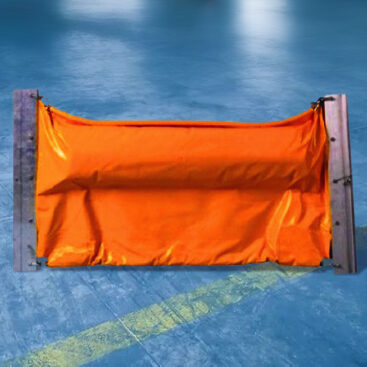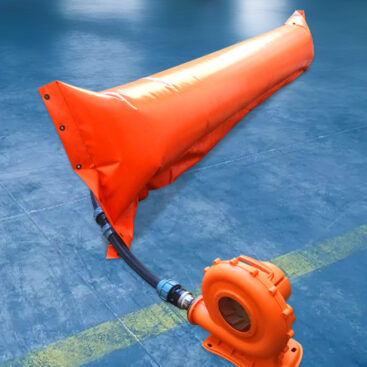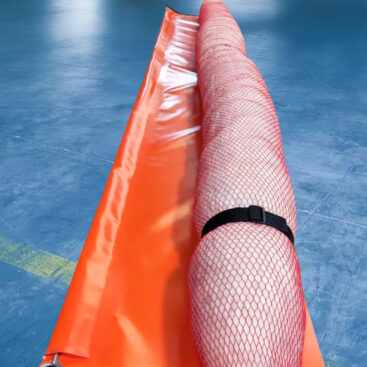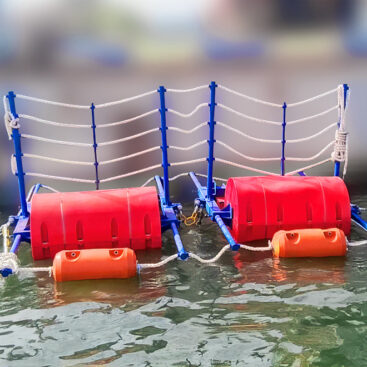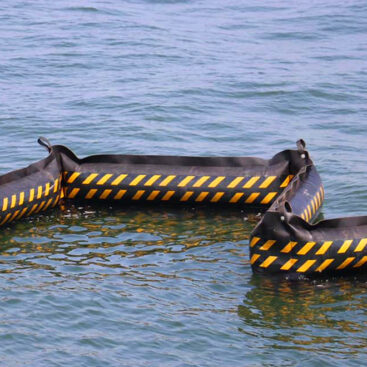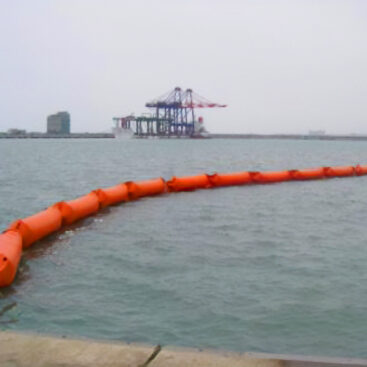


ECONAD Floating Debris Booms are designed to contain, control and collect floating waste, vegetation and other debris from the water surface.
The barriers provide a reliable solution for protecting water intakes, hydroelectric facilities, dams, ports, rivers, canals and other areas where floating debris may interfere with operations or cause environmental pollution.
The modular construction allows the barrier length and configuration to be adapted to different waterways and installation conditions.
ECONAD Debris Booms can be used for:
- Hydroelectric power stations
- Water intake structures
- Dams and reservoirs
- Rivers and canals
- Ports and harbours
- Coastal and marine areas
- Industrial water facilities
- Waste and vegetation collection
- Protection of sensitive water infrastructure
- Permanent or temporary debris-control installations
The floating barrier forms a continuous physical line across or around the protected water area, helping prevent floating debris from entering critical zones.
Depending on the project requirements, the boom can be positioned to intercept debris and guide it towards a designated collection or removal point.
The system can be configured for both permanent installations and temporary environmental protection operations.
The barrier is manufactured from robust materials selected for long-term operation in marine and freshwater environments.
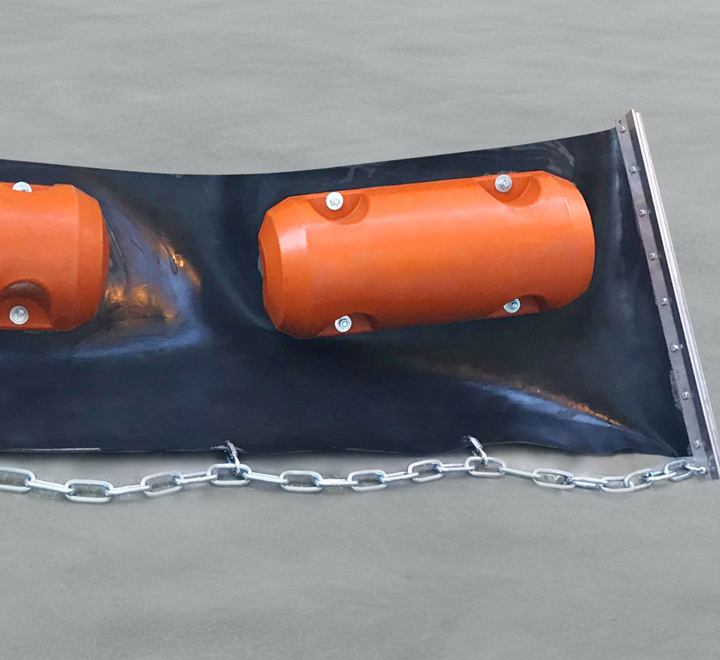
The main construction includes a durable oil- and fuel-resistant rubber base combined with polyethylene floats and corrosion-resistant connecting components.
The materials provide resistance to:
- UV radiation
- Water exposure
- Abrasion
- Oil and petroleum products
- Marine environmental conditions
- Repeated mechanical loads
High-quality polyethylene floats provide the buoyancy required to maintain the barrier in the correct operating position.
The floats can be foam-filled to provide additional reserve buoyancy and help maintain flotation even if the outer shell is locally damaged.
Individual floats are detachable from the main barrier structure, simplifying cleaning, inspection and replacement when required.
A galvanized steel chain or other ballast system is installed along the lower part of the barrier.
The ballast helps maintain the vertical position of the boom and improves stability under changing water conditions.
The barrier is designed to accommodate natural water movement, including fluctuations caused by tides and variations in water level.
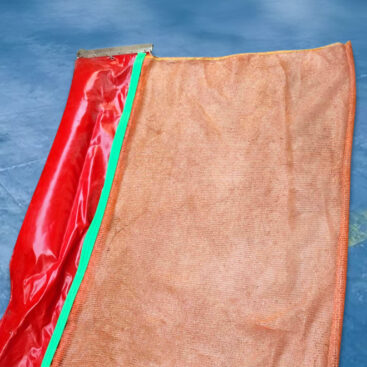
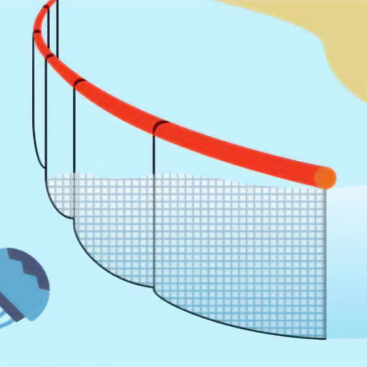
For applications requiring deeper protection, a heavy-duty HDPE net can be installed below the floating barrier.
The net increases the effective depth of the system and helps capture partially submerged debris that could otherwise pass beneath the boom.
The depth and specification of the net can be selected according to the expected debris type, water depth and operating conditions.
Individual boom sections can be connected to create barriers of different lengths.
Standard quick-connect fittings allow sections to be assembled, separated and repositioned when required.
Anchor attachment points can also be installed at regular intervals near the floats or end connectors, allowing the mooring arrangement to be adapted to the site conditions.
For areas exposed to particularly high debris loads, the barrier can be reinforced with a high-strength steel wire.
This configuration increases the tensile capacity of the system and is suitable for applications where large quantities of floating debris, branches or other heavy objects may accumulate against the barrier.
Every debris-control project has different environmental and operational requirements.
ECONAD can configure the barrier according to:
- Required protection length
- Type and quantity of floating debris
- Water depth
- Current velocity
- Wave conditions
- Tidal variation
- Expected debris loads
- Required barrier depth
- Existing shore structures
- Available anchoring points
- Permanent or temporary installation requirements
Based on this information, the appropriate boom dimensions, flotation system, ballast, submerged net and anchoring arrangement can be selected for the project.
- Effective Debris Control: Helps contain floating waste, vegetation and other debris before it reaches protected areas.
- Durable Construction: Materials are selected for prolonged operation in freshwater and marine environments.
- Modular Design: Individual sections can be connected to create barriers of different lengths and layouts.
- Replaceable Floats: Detachable polyethylene floats simplify inspection, maintenance and replacement.
- Optional Submerged Net: Additional HDPE netting increases the effective protection depth and captures partially submerged debris.
- Stable Performance: Ballast and anchoring systems help maintain the required position of the barrier under changing water conditions.
- Heavy-Duty Options: Additional reinforcement can be provided for locations exposed to significant debris loads.
- Custom Engineering: Barrier dimensions, net depth, flotation and anchoring can be adapted to specific site conditions.
Debris Control Solutions for Your Facility
ECONAD provides floating debris barriers for hydropower facilities, ports, dams, water intakes, rivers and industrial water infrastructure.
Contact us for:
- Preliminary project assessment
- Selection of the appropriate barrier configuration
- Calculation of required boom length
- Submerged debris net selection
- Anchoring and mooring recommendations
- Custom manufacturing
- Technical consultation
- Commercial quotation
Send us information about the required protection length, water depth, current conditions and expected type of debris to receive a suitable barrier configuration.
| Barrier boom height: | from 75cm |
| Thickness of oil and petrol resistant rubber base: | from 4mm |
| Floats: | cylindrical shape 30 cm in diameter and 70 cm in length |
| Balast: | galvanized chain, gauge 10 |
| Mount: | metal universal mounts (AMG5) |